World
Locations, roads, terrain and scenery define where exploration happens.
Kav: Golden Hour is my live 3D browser adventure. It starts with the atmosphere of the Palisades in Laguna Niguel and grows into a world of city life, wildlife and unexpected destinations.
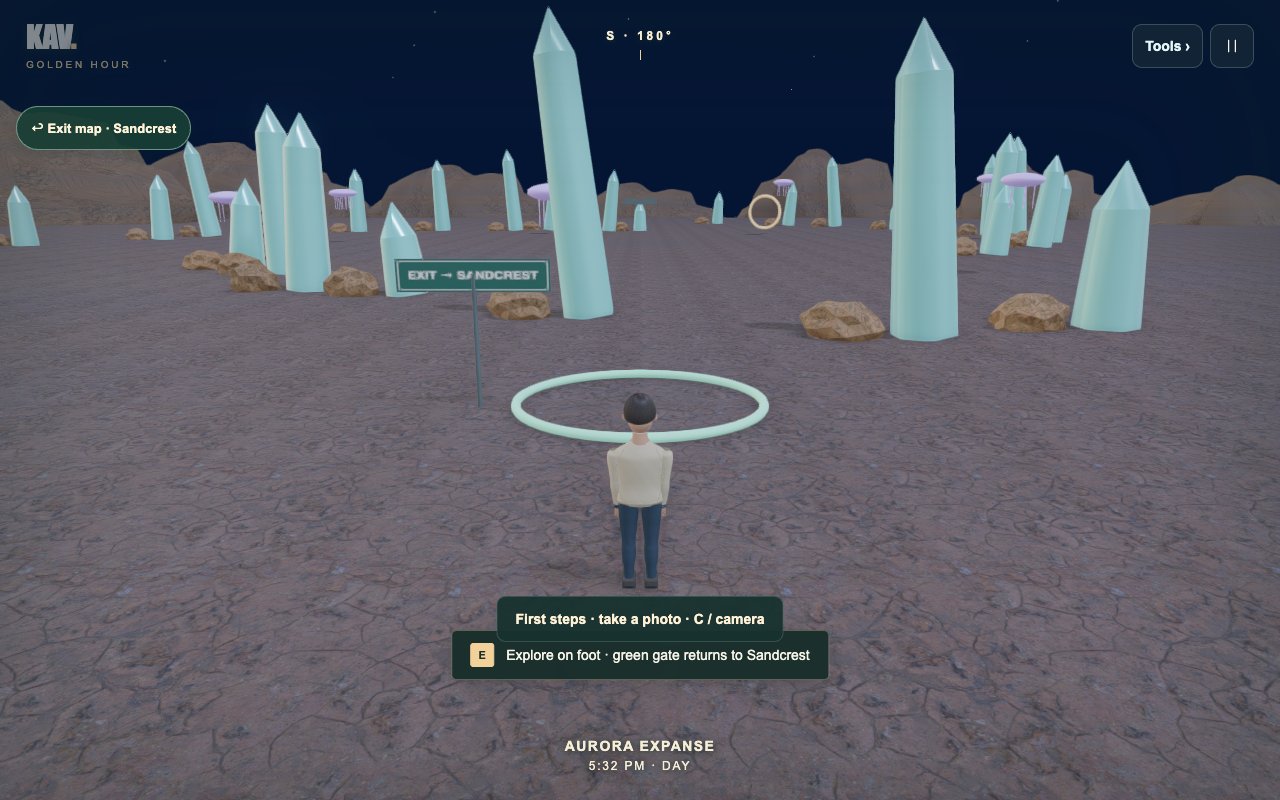
Start in Sandcrest, pass through a prehistoric valley and cross into Aurora Expanse. Play the silent trailer with English captions.
Kav walks past the red concept car in Sandcrest, then past the return gate in Cretaceous Valley, where dinosaurs roam between the trees. The final scene follows Kav across the crystal fields of Aurora Expanse.
In one browser studio view, the full-detail car and floor drew about 213,000 triangles. The lightweight car and floor drew about 30,000.
The design begins with a simple invitation: walk somewhere interesting and see what happens.
Exploration connects ordinary activities with discoveries beyond the city. Residents, animals, vehicles, missions and seasonal details give places a sense of activity. Portals introduce other settings while the home world provides a familiar place to return.
My work covers creative direction, programming, world assembly, gameplay integration and continued testing. The project combines custom systems with adapted licensed assets; credits identify the sources.
Read the design process ↗Locations, roads, terrain and scenery define where exploration happens.
Movement, collision, resident routines and interactions give the world behavior.
Materials, lighting, animation and sound make changes in that world perceptible.
Scene inspection, device recordings and regression checks inform the next build.
An overview of implemented systems, rather than a claim of a fully physical or universally photorealistic simulation.
Nearby obstacle lookup reduces repeated map-wide searches while retaining the existing collision tests. Residents use bounded local routines and navigation behavior. These are authored game systems, rather than an unrestricted learning service.
Detailed vehicles, layered character surfaces and instanced scenery build visual presence. Shared geometry and distance-based detail reduce repeated work. Adapted art and procedural systems contribute different parts of the result.
Elapsed-time damping smooths changes between states. Procedural character animation and vehicle body responses support movement without claiming motion capture or calibrated real-world dynamics.
Picture settings, staged loading and device recordings help balance image detail with responsiveness. Frame intervals and available CPU/GPU timings make performance easier to examine on the actual device.
Follow three steps through world design, asset inspection and play testing.
Take the Golden Hour tour ↗Rotate and zoom the actual concept car, boat, resident and mule deer models, then inspect their geometry, material views and labeled details. Explore the steering and animation mathematics behind their game integration. The accompanying notes explain where each model is an approximation.
Car Concept by Eric Chadwick / Darmstadt Graphics Group GmbH, adapted under CC BY 4.0. The showcase includes source and license attribution.
Vehicle detail, character presence, movement checks and staged loading.
WORLD GUIDEExplore the game and picture settings ↗A practical introduction to the live experience and its controls.
SCENE INSPECTIONLocations, creatures and transport in 3D ↗Explore the game’s asset families in the separate detail studio.